Background
Candida is commonly recovered from sputum in cystic fibrosis and bronchiectasis, and clinical convention is to call it colonisation and leave it alone. The reasoning is that Candida does not cause invasive lung infection in people with normal immune systems, so a positive culture is treated as background noise — a marker of advanced disease and heavy antibiotic exposure rather than a contributor to either.
That reading is harder to sustain than it first appears. Studies have linked Candida in the airway to exacerbations requiring hospital treatment and to faster lung function decline, in analyses that account for the antibiotic exposure supposedly explaining its presence. Mixed fungal–bacterial biofilms have been associated with disease progression and with increased bacterial pathogenicity, by mechanisms that remain poorly understood.
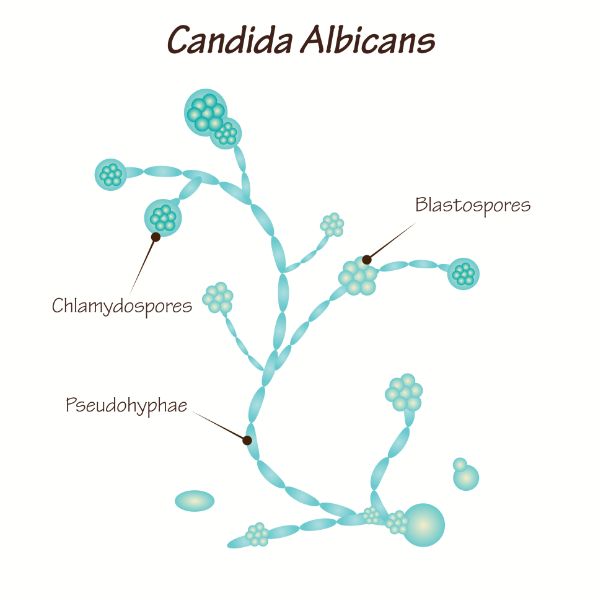
Part of the explanation may be that Candida is not one thing. It is a dimorphic fungus, growing either as yeast or as filamentous hyphae, and individual strains differ in the virulence machinery they carry — most notably candidalysin, a peptide that damages epithelial cells and provokes inflammation. Candida also acts on the bacteria around it, and bacterial disruption in turn influences how Candida grows. The airway has been largely left out of this literature, and the question has become more pressing as the microbiology of cystic fibrosis shifts in the era of modulator therapy.
Our working hypothesis is that the coloniser-or-pathogen dichotomy is the wrong frame. Candida likely sits on a spectrum from harmless commensal to potentiator — an organism that causes little damage on its own but amplifies the growth and virulence of neighbouring bacteria and the inflammation they provoke.
What we are doing
We work from a longitudinal biobank in which airway samples and the fungal isolates cultured from them were archived from the same patients at the same timepoints. That pairing lets us follow individuals across periods of stability and exacerbation and ask what their Candida was doing at each. Three lines of work run in parallel:
- Community profiling of bacteria and fungi together, so that fungal colonisation can be interpreted in the context of the community it sits within rather than in isolation;
- Characterisation of patient-derived isolates — how they grow, which form they take, what virulence factors they carry, and how they respond to antifungal drugs;
- Co-culture and cell-based experiments, testing whether Candida changes the growth and virulence of common airway bacteria, and measuring the resulting damage to human airway epithelial cells.
To move from association toward mechanism, we work with a human lung-on-a-chip model developed by our collaborators: a ventilated airspace lined with human airway epithelium above perfusable blood vessels, giving a realistic air–blood interface. Infecting that system with and without fungal co-colonisation lets us watch epithelial injury, vascular leak, and immune cell recruitment happen in real time, and test whether targeting the fungus — or the specific virulence factor it produces — reduces the damage.
Why it matters
If Candida in the airway were uniformly harmless, current guidance would be correct and nothing would need to change. If instead its effect depends on which strain is present, then the useful clinical question is not “is Candida there” — which laboratories already answer, and which nobody acts on — but “which Candida is it”, which nobody currently asks. That distinction would determine whether antifungal treatment is pointless or targeted, and it opens a different therapeutic route altogether: blunting a bacterial exacerbation by disarming a fungus. For people with cystic fibrosis and bronchiectasis, a modifiable amplifier of airway inflammation is worth identifying.